 Soundly
Yes, they can, and the fear attached to this question — am I confusing my child? — is rejected by the professional bodies that assess children for a living.
ASHA, the American Speech-Language-Hearing Association, puts it plainly: bilingualism does not delay or interfere with language and learning acquisition.1 A review of the research on language mixing found no negative effect on bilingual language acquisition, and that differences in word use or grammar do not themselves indicate a disorder.2
Why one language can still look behind
Here is the thing that causes the worry, and it is arithmetic rather than a problem.
A bilingual child's vocabulary is split across two languages. Counted in one language alone they can look behind a monolingual child. Counted across both, the total is comparable or larger.
So a well-meaning count of English words at a playgroup produces a number that means very little. The measure that matters is the child's whole vocabulary, in every language they have.
The one sign that does matter
This is the genuinely useful distinction, and it is simple: a real language delay shows up in both languages. A child who is behind in one language and fine in the other is showing you a difference in exposure. A child who is behind in both is a child to get assessed.
If you are in that situation, see what the milestones say about talking at two — and the advice there stands: ask a professional rather than an article. One thing clinicians specifically advise against is dropping your home language and switching to English on the assumption it will help.1 Families do best in the language they are most comfortable in.
When is the easiest time to start?
Earlier, mostly for pronunciation. Beginning before roughly age seven is associated with native-like accent and a more intuitive grasp of structure, and younger learners outperform older ones on phonology in particular.3
The honest caveat the internet usually drops: the critical-period literature is not unanimous. Some studies find no clear advantage by starting age, and the effect is much easier to demonstrate for accent than for vocabulary or grammar. The true claim is about ease and pronunciation, not about fluency being impossible later. Plenty of adults learn languages well.
What that looks like in practice
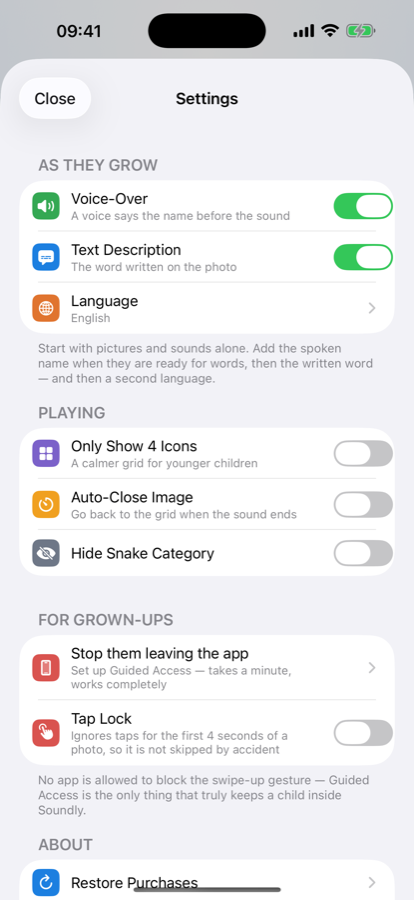
Voice-Over, Text Description and Language are three separate switches in Soundly, so the spoken name, the written word and the second language can each be turned on when the child is ready — not all at once. This is the app, not a mock-up.

is one of the nineteen languages in Soundly Pro — the word written, and spoken by a native speaker. Get the app.
Tap English to hear the word read by the voice actor, then the cow itself. Tap any other language to see which ones are there — Norsk, Deutsch, Français, 日本語 and fifteen more — and the word written and spoken in each is what Soundly Pro adds. The trick with a small child is the same either way: the photograph and the sound carry the meaning, so the only new thing is the word.
That is the practical trick with a small child: do not teach the second language as a separate subject. Attach a second name to something they already recognise. The picture and the sound carry the meaning; the word is the only part that changes.
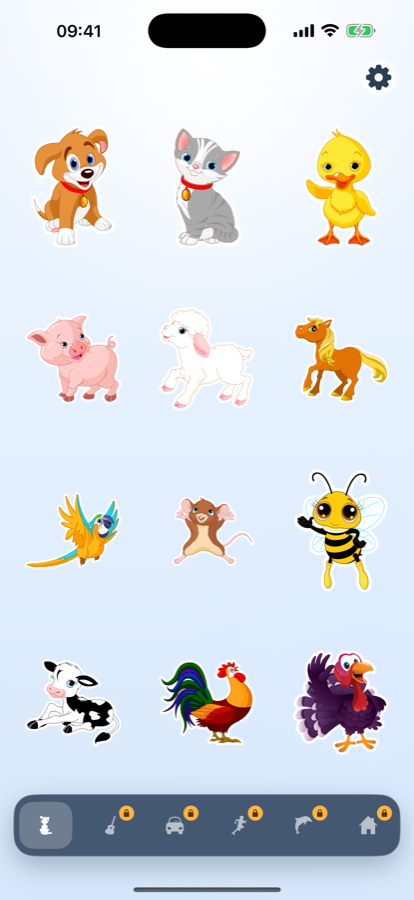
Soundly ships 19 languages for exactly this, each spoken by a native voice, and you can switch between them on the same picture. The twelve farm animals are free — hear them here, or see every animal name in all 19.
Hear all 361 of them
Soundly is 360 real photographs and 361 real recordings across six worlds, in 19 languages, read by a human voice actor. The twelve farm animals are free.


References
- The ASHA Leader — "bilingualism does not delay or interfere with language and learning acquisition", and guidance that clinicians should not advise families to switch to English.
- Grech, H., & Dodd, B., review on bilingual language acquisition and language mixing. PDF.
- Hartshorne, J. K., et al. A critical period for second language acquisition: evidence from 2/3 million English speakers, Cognition; and Bilingualism: Language and Cognition, Cambridge.